It is 9:40 on a Saturday night. Someone has seen your ad, or your Instagram, or your Google listing, and they send you a WhatsApp message. "Hi, how much for this?"
You see it on Sunday afternoon. You reply on Monday morning with a price list and a friendly note. By then, the person has already messaged two other businesses, got a reply from one of them within the hour, and booked.
Nothing was wrong with your product or your price. You lost that customer in the gap between their message and your reply.
In Malaysia, this happens every day. WhatsApp is where business gets done. People enquire through a website button, an ad, a Facebook page or a DM, and then move straight to WhatsApp because it is familiar and quick. The first few messages in that chat decide whether a stranger becomes a customer.
The good news is that this is one of the easiest parts of your marketing to improve, and it costs almost nothing.
Speed Is Part of the Message
When someone enquires, they are in a buying mindset right now. That window does not stay open for long. People rarely message just one business. They send the same question to a few, and tend to go with whoever answers first and answers helpfully.
A fast reply does not only win the race. It tells the customer something about you: that you are organised, that you care and that you are likely to look after them once they have paid.
You do not have to be glued to your phone at all hours. What you need is a way to respond quickly, even when you are busy or asleep.
If you use the free WhatsApp Business app, you can set up a greeting message that goes out automatically when someone writes to you for the first time, and an away message for outside your working hours. Something as simple as this works well:
"Hi, thanks for messaging us. We reply between 9am and 6pm, Monday to Saturday. While you wait, tell us what you are looking for and we will get back to you with the details."
That one short message does three things. It confirms they have reached the right place, it tells them when to expect a reply, and it gets them talking. Customers are far more patient when they know what to expect.
Do Not Answer "How Much" With Only a Number
This is the most common question you will get, and it is also where many conversations die. There are two ways to get it wrong.
The first is sending a price with nothing around it. A number on its own, with no context, makes people compare you to the cheapest option on the internet and walk away.
The second is dodging. Replying "please PM us for details" or "price depends" with nothing else feels evasive, and customers will not wait around to find out what you meant.
A better approach is to give them something real, then ask a question that helps you help them. For example:
"Hi Sarah, thanks for asking. Our cleaning packages start from RM180 for a two-bedroom apartment. The final price depends on the size of your place and what needs doing. Roughly how big is your home, and when would you like us to come?"
Notice what that reply does. It answers the question honestly. It uses their name. It explains why the price can change, which builds trust. And it ends with one easy question, which keeps the conversation moving.
Write Like a Person
Customers can tell very quickly whether they are talking to a human or reading a copy and pasted script. Long blocks of text, formal wording and a full brochure dumped into the chat all make people feel like a number.
A few habits help:
Keep messages short. Two or three sentences at a time is usually enough.
Use their name, and use your own. "Hi Sarah, this is Amir from the shop" is warmer than a message with no introduction.
Reply in the language they used. Many Malaysians switch between Malay, English and sometimes Mandarin or Tamil within the same chat. If they write in Malay, answer in Malay. If it is a mix, a mix is fine. Matching how they speak makes them feel understood.
Ask one question at a time. Three questions in one message feels like a form to fill in. One question feels like a conversation.
Make the Next Step Obvious
A lot of chats fizzle out because nobody ever says what should happen next. The customer was interested, you were helpful, and then the conversation just stops.
Finish each message with a clear, easy next step. It could be booking a slot, visiting the shop, getting a quote or making a payment. Giving two options is often easier for people than leaving it open:
"Would Thursday at 3pm or Friday morning suit you better?"
That works far better than "let me know when you are free", because it takes the effort of deciding out of their hands.
Follow Up Without Being Annoying
Here is something that surprises many owners: most leads that go quiet have not said no. They have simply been busy, distracted or waiting for something. A polite follow-up is often what brings them back.
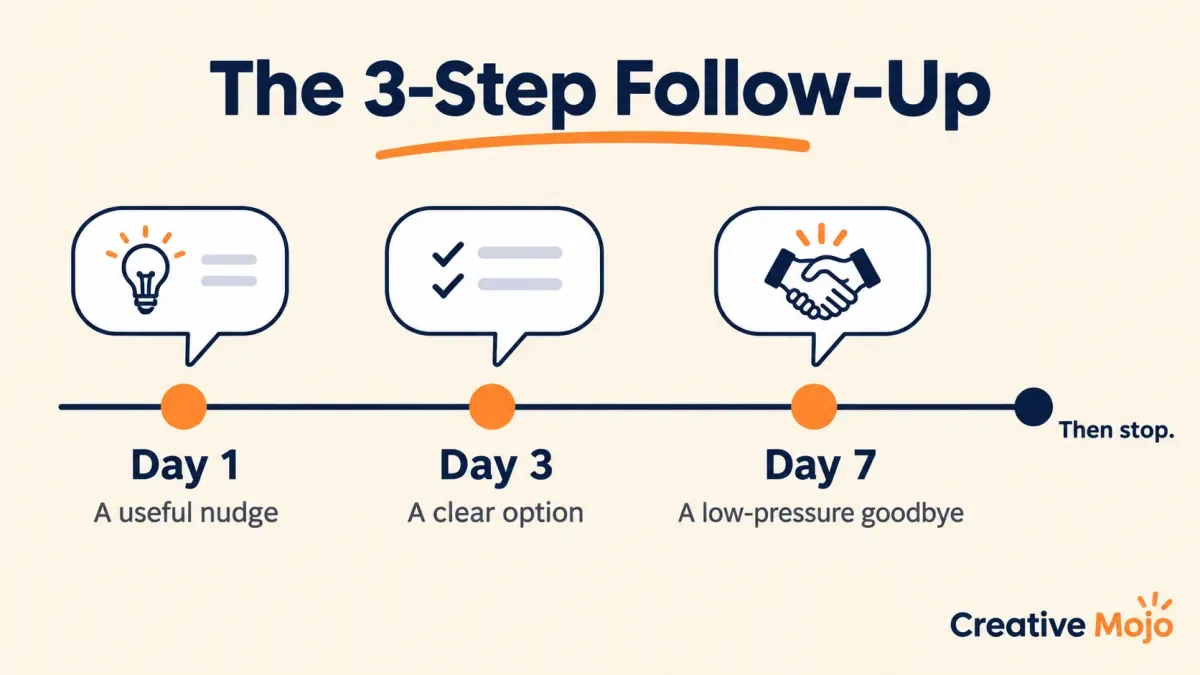
The trick is to follow up with something useful, not just "Hello? Are you still interested?" Here is a simple pattern:
After about a day: a friendly nudge that answers a question they might have. "Hi Sarah, just checking in. If it helps, here is a photo of the kind of finish you can expect."
After about three days: a gentle reminder with a clear option. "We still have a few slots open this week if you would like to go ahead."
After about a week: a final, low-pressure note. "No worries if the timing is not right. Just message us whenever you are ready and we will be happy to help."
Then stop. Three messages is respectful. Ten is pestering. And that last message often gets replies, because it takes the pressure off.
Keep Track So Nothing Slips
If you are getting more than a handful of enquiries a week, memory stops being reliable. Leads get buried under new chats, and the ones that needed a follow-up are forgotten.
The WhatsApp Business app lets you label chats, for example "New enquiry", "Quote sent", "Follow up" and "Booked". Even a simple spreadsheet with names, dates and status works. What matters is that one person is responsible for checking it, and that it happens at set times. If you work alone, pick two times a day, such as mid-morning and late afternoon, and clear your enquiries then.
Small Mistakes That Cost Sales
A few habits quietly lose customers:
Sending a PDF brochure with no message. It feels cold and puts the work of reading it on the customer.
Reading a message and not replying. People can see the blue ticks. Leaving someone on read feels worse than a slow reply.
Adding people to promotional broadcasts without asking. Only message people who have enquired or agreed to hear from you. It respects their privacy, keeps you on the right side of the rules and avoids annoying people who might otherwise buy from you later.
Replying only when you have the full answer. A short "Got your message, I will check and come back to you within the hour" is much better than silence.
If You Run Ads, This Matters Even More
If you pay for ads that send people to WhatsApp, reply speed directly affects what each customer costs you. You have already paid for the click. A slow or cold reply wastes that money before the conversation even begins.
It is common to see a business blame its ads when the real problem is what happens in the chat afterwards. The ads delivered the person. The conversation lost them. Before you spend more on advertising, it is worth looking honestly at how you handle the enquiries you already get.
A Simple Starting Point
You do not need any special software to improve this. This week, you could do four things: set up a greeting and an away message, write a short template for the "how much" question that you adjust each time, decide on your three-step follow-up pattern, and choose two daily times to clear your enquiries.
None of it is complicated. Most businesses simply never get around to it, which is why handling it well can give you a quiet edge over competitors who are doing everything else right.
Not Sure Where Your Leads Are Slipping Away?
If you are getting enquiries but fewer sales than you expect, the answer is often somewhere in this first stretch of the conversation. We are happy to take a look at how your enquiries are handled and suggest what to tighten up first. You can get in touch with us here: https://creativemojo.asia/contact
A short conversation now can save you a lot of customers later.