
For many SMEs, a website feels like a necessary milestone. Once it is live, it gives a sense of legitimacy. Customers can find you, learn about your services, and reach out when they are ready.
But here is the uncomfortable truth.
Having a website does not automatically mean it is working for your business.
Many small business owners invest time and money into building a website, only to realise later that it is not bringing in inquiries, bookings, or sales. Visitors come and go, but nothing really happens. It becomes a static presence rather than an active part of the business.
If that sounds familiar, the issue may not be visibility. It may be how your website is performing once people arrive.
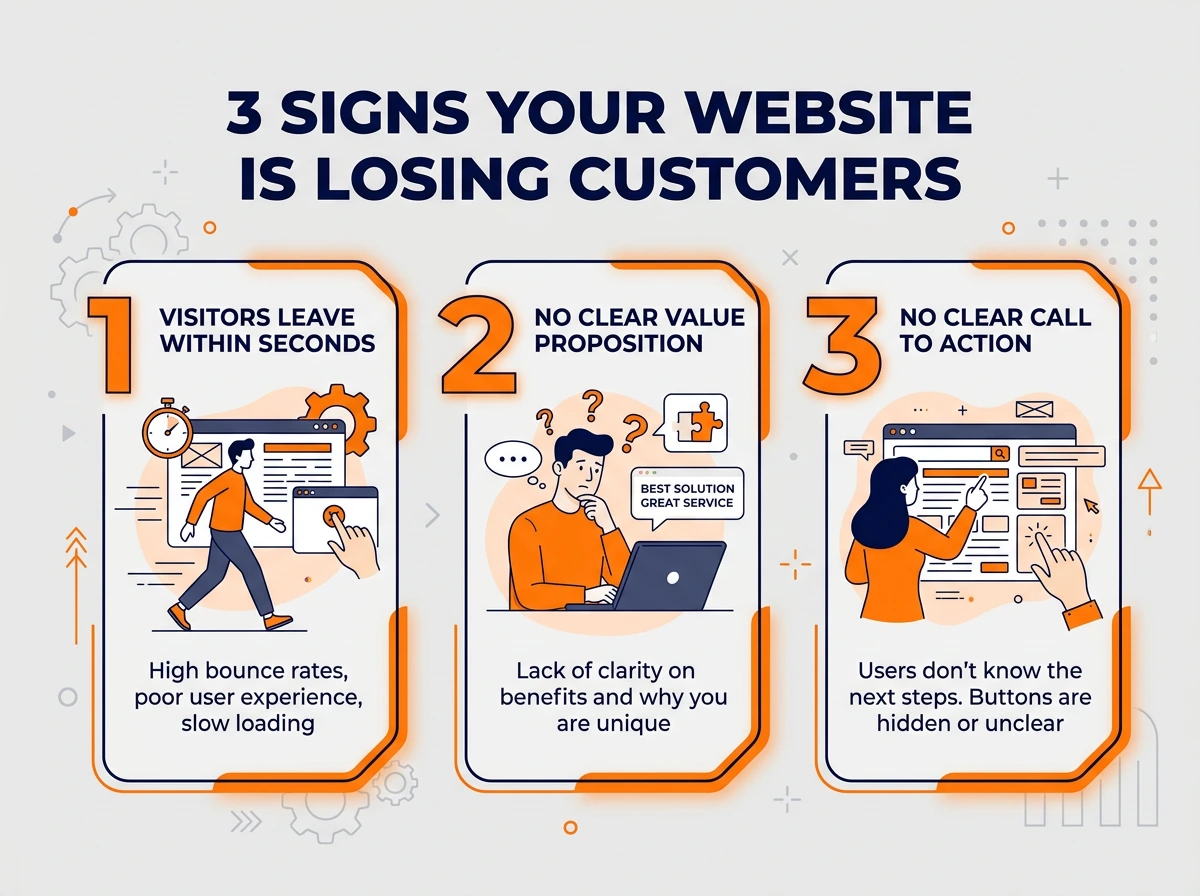
One of the earliest signs that something is not working is when visitors leave almost immediately. When someone lands on your website, they are subconsciously asking a simple question. What is this business about, and is it relevant to me?
If the answer is not clear within the first few seconds, most people will not stay long enough to figure it out. This often happens when the homepage tries to say too many things at once, or when the message is buried under unnecessary text and visuals. Instead of guiding the visitor, the website creates friction. And in a digital environment where attention spans are short, friction almost always leads to exit.
If your website is not bringing in the results you expect, it may be time to look beyond surface-level changes and focus on the foundation. Because in the end, a website should not just exist. It should perform.
Clarity is what keeps people engaged. A strong homepage should quickly communicate what you do, who you help, and why it matters. When that message is immediate and easy to understand, visitors are far more likely to stay and explore further.
Another common issue lies in how a business presents its value. Business owners naturally understand their own services, but customers do not share that same level of familiarity. When a website uses vague or generic phrases, it forces visitors to interpret the message on their own.
Statements like providing quality services or delivering excellence may sound professional, but they do very little to help a potential customer understand what is actually being offered. Without a clear and specific value proposition, even an interested visitor can feel uncertain.
A more effective approach is to speak directly to a defined audience and a specific need. When a visitor can immediately recognise that a service is relevant to them, trust begins to build. That clarity reduces hesitation and makes it easier for them to take the next step.
Which brings us to another subtle but critical problem. Even when a visitor understands your business and is interested in what you offer, many websites fail to guide them on what to do next. There is no clear direction, no visible prompt, and no obvious path forward.
In these situations, potential customers often leave not because they are uninterested, but because they are unsure. A website should not leave decisions to chance. It should gently but clearly guide visitors towards a specific action, whether that is making an inquiry, booking a service, or getting in touch.
Simple and visible calls to action make a significant difference. When the next step is obvious and easy, more visitors are likely to convert into actual leads.
All of this points to a broader misunderstanding that many SMEs have about marketing. When results are slow, the instinct is often to increase visibility. More ads, more social media activity, more effort to drive traffic.
But traffic alone does not solve the problem if the foundation is weak.
If a website cannot clearly communicate value or guide visitors towards action, bringing in more people will simply result in more missed opportunities. Growth does not come from visibility alone. It comes from what happens after someone arrives.
A well-structured website functions much like a good salesperson. It introduces your business clearly, builds confidence through its presentation, and leads the customer towards a decision. It works consistently, without interruption, supporting your business around the clock.
When those elements are in place, marketing becomes more effective as a whole. Efforts across social media, advertising, and search all begin to reinforce each other, rather than working in isolation.
For SMEs looking to improve their online presence, the starting point is not always doing more. Sometimes, it is about refining what is already there.
A clearer message, a stronger value proposition, and a more intentional user journey can transform a website from a passive asset into an active driver of growth.
If your website is not bringing in the results you expect, it may be time to look beyond surface-level changes and focus on the foundation. Because in the end, a website should not just exist. It should perform.
If your website isn’t bringing in inquiries or leads, it might not be doing its job properly.
At Creative Mojo, we help SMEs build websites that are clear, strategic, and designed to convert visitors into real customers.
If you’re ready to turn your website into a growth tool instead of just an online presence, let’s start with the right foundation.

Is this your situation right now?
If you are spending on marketing but not seeing the returns, a clarity conversation is usually where we start. Tell us about your business and we will give you an honest read on what is going on.
Book a Free Discovery Call