Let's be honest. When most business owners say they're "doing marketing," what they usually mean is they're posting on Instagram, boosting a Facebook ad here and there, maybe sending out a WhatsApp blast to their contacts list. It feels like marketing. It looks like marketing. And yet, month after month, the results are inconsistent. Some months decent, other months crickets. Nobody can quite explain why.
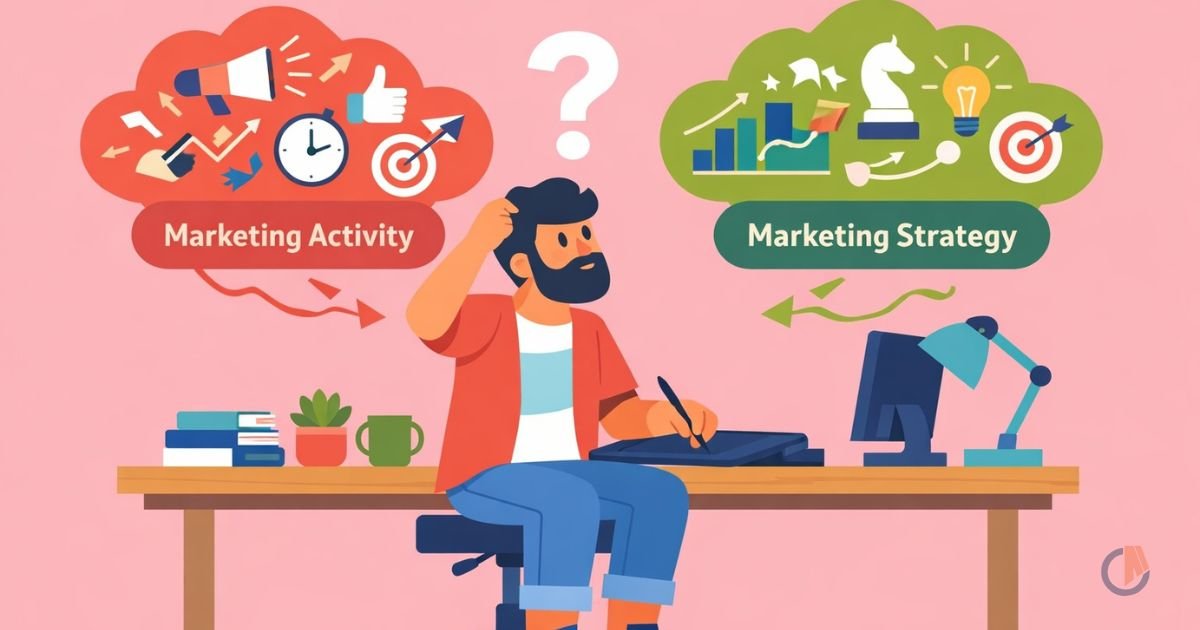
The reason, more often than not, is this: they're doing marketing activity, not marketing strategy. And the difference between those two things is enormous.
Activity Feels Like Progress (But Isn't Always)
Marketing activity is anything you do in the name of marketing. Posting content. Running ads. Sending emails. Attending networking events. Updating your website. These are all real things that take real time and effort, and none of them are wrong on their own. The problem is when they happen without a clear reason behind them. When you're posting because you feel like you should, running ads because a competitor is doing it, or trying a new platform because someone in a WhatsApp group said it worked for them.
Activity without strategy is essentially guessing. You might guess right sometimes, which is why it occasionally produces results. But you can't learn from a lucky guess. You can't scale it. You can't replicate it reliably. And when it stops working, you're back to square one, wondering what went wrong.
Here's a simple way to think about it: activity answers the question "what are we doing today?" Strategy answers the question "why are we doing this, and how does it connect to where we want to go?" One is about motion. The other is about direction.
The Instagram Trap
Social media is probably the biggest culprit when it comes to confusing activity with strategy. It's immediate, it's visual, and it gives you constant feedback in the form of likes and comments. So it feels meaningful. It feels like it's working, even when it isn't moving the business forward at all.
I've spoken to SME owners who have been posting on Instagram five times a week for two years straight, and when I ask them what it's actually done for their business, they struggle to answer. They might say their followers have grown a bit. Maybe they get the occasional DM. But consistent enquiries? New clients who found them through Instagram specifically? A measurable lift in revenue they can trace back to their social media effort? Usually not.
That's not because Instagram doesn't work. It's because posting is not a strategy. Posting consistently is a habit, and it's a good habit to have, but by itself it doesn't constitute a marketing strategy. A strategy would start with questions like: who exactly are we trying to reach on Instagram, what do we want them to think or feel after seeing our content, and what specific action do we want them to take?
From the answers to those questions, you build a content approach. You decide what to post, how to write it, what imagery to use, and how to guide someone from follower to enquiry to client. That's strategy. The posting itself is just the execution of it.
Ads Are Not a Strategy Either
The same logic applies to advertising. Paid ads, whether on Meta, Google, or TikTok, are a tool. A powerful one, but still just a tool. And like any tool, how useful it is depends entirely on how well you know what you're using it for.
A lot of SMEs run ads reactively. Business is slow, so they boost a post. They get a few clicks, maybe a handful of leads, and then the budget runs out and they're back to where they started. Or worse, they spend a decent amount, don't see the return they hoped for, and conclude that "ads don't work for us." What usually happened is not that ads don't work. It's that the ads weren't part of a system.
A proper advertising strategy doesn't just ask "how much should we spend?" It asks: what is the goal of this campaign? Who are we targeting, and how specifically? What does the landing page look like, and is it actually designed to convert? What happens after someone clicks? Is there a follow-up sequence, a sales process, a way to capture leads even if they don't buy immediately? What does success look like, and how will we measure it? Without answers to those questions, you're not running an ad campaign. You're just spending money and hoping.
Systems vs. One-Off Efforts
This brings us to what I think is the most useful distinction of all: strategy is about building systems, while activity is about one-off efforts.
A one-off effort might produce a result. A system produces results repeatedly. The difference is that a system is designed. It has inputs, outputs, and feedback loops. You know what you're putting in, you know what you're expecting to get out, and you track it so you can improve over time.
For an SME, a simple marketing system might look something like this: you create content that attracts a specific type of person, that content drives them to your website, your website is set up to capture their details or prompt them to get in touch, your follow-up process moves them from interested to committed, and you review what's working every month so you can do more of the right things. That's not complicated. But it's intentional. Every piece connects to the next.
Compare that to the typical SME marketing approach, which looks more like: post some content when there's time, run an ad when there's budget, follow up with leads whenever, and then wonder why growth feels so unpredictable. There's nothing connecting the pieces. Nothing feeds into anything else. It's just activity.
Strategy Starts With Clarity, Not Creativity
One thing I always tell clients: before you worry about what to post or which platform to use, get clear on the fundamentals. Who are your best customers, and what do they care about? What problem do you solve for them, and why are you the right person to solve it? What does your business need from marketing right now, whether that's awareness, leads, or repeat business? Where does your ideal customer actually spend their time, and where are they most likely to discover you?
Once you're clear on those things, the tactical decisions become much easier. You'll know which platforms are worth your time and which ones you can ignore. You'll know what kind of content will actually resonate versus what's just filling space. You'll know how to write your ads so they speak to the right people rather than everybody and nobody at the same time.
A lot of business owners skip this step because it doesn't feel like doing anything. You're not posting, you're not spending, you're not producing anything you can point to. But this thinking stage is exactly where strategy lives, and skipping it is why so many businesses end up in the trap of constant activity with inconsistent results.
You Don't Need to Do Everything. You Need to Do the Right Things.
One of the most useful things that comes out of having a real marketing strategy is realising how much you can stop doing. When you're clear on what works and why, you can drop all the things you were doing out of obligation or FOMO. The platform you never really understood, the content format that took ages to produce but never got traction, the ad campaigns you ran because everyone else seemed to be running them.
Strategy gives you permission to be selective. And for a small business with limited time and budget, being selective is not a weakness. It's the smartest thing you can do. Better to do three things well and consistently than to do ten things half-heartedly and call it a marketing strategy.
If you're an SME owner reading this and it sounds uncomfortably familiar, the good news is that you don't need to overhaul everything overnight. Start by asking one honest question: of everything we're currently doing in the name of marketing, which specific activities can we point to as driving real business results? If the answer is vague, or if you genuinely aren't sure, that's your signal to step back from the activity and invest some time in the strategy.
The doing matters. But the thinking matters more.
Not Sure Where Your Marketing Stands?
If you've read this far and you're not quite sure whether your business has a real marketing strategy or just a busy schedule, that's a good place to start. At Creative Mojo, this is exactly the kind of conversation we have with SME owners every day.
We look at what you're doing, figure out what's actually working, and help you build a clear plan around that so your time and money go further. No complicated frameworks, no generic advice. Just a straight conversation about your business and where marketing can genuinely move the needle.
Get in touch here and let's talk about what a proper strategy could look like for you.

Is this your situation right now?
If you are spending on marketing but not seeing the returns, a clarity conversation is usually where we start. Tell us about your business and we will give you an honest read on what is going on.
Book a Free Discovery Call